The Mixtures experiment, under the co-supervision of Prof. Matthias Weidemüller and Prof. Lauriane Chomaz (Quantum Fluids Group), investigates fundamental paradigms of quantum few- and many-body physics. We tune interactions and quantum statistics in ultracold gases of Lithium (fermionic) and Cesium (bosonic) atoms and study a myriad of fascinating effects in strongly interacting quantum matter under extreme control, including Bose-Einstein condensates, degenerate Fermi gases, and mixtures of both in different regimes of quantum degeneracy.
Polaron physics
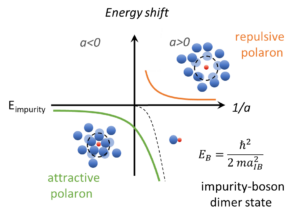
The problem of the coupling of an impurity to a surrounding quantum bath lies at the heart of a large variety of quantum many-body phenomena. A degenerate ultracold mixture of Li and Cs atoms gives access to both physically relevant limits of light impurities coupled to a Bose-Einstein condensate and of heavy particles to a degenerate Fermi sea, non-trivial paradigms of many-body systems. Our experimental investigations are based on spectroscopic measurements performed on the minority species in regimes where it is strongly interacting with the quantum bath. We are interested, on one hand, in the role played by the mass of the impurity in the dynamics of the many-body system and on the other hand, in the role played by quantum bath as a mediator of interactions between impurities.
status: ongoing project
Efimov physics
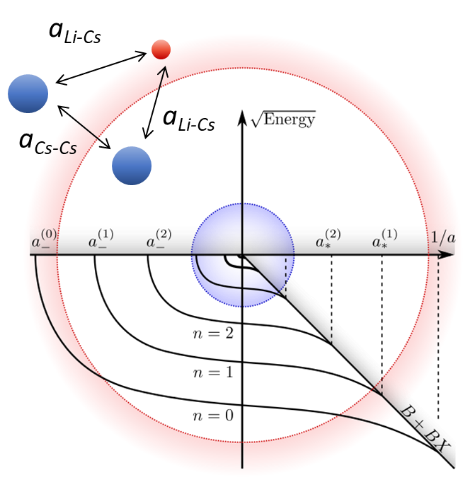
The Efimov effect concerns the bizarre property of the quantum three-body problem for which three particles can be bound even if the two-body system is unbound. The ratio between two subsequent trimer energies follows a discrete scale invariance with a universal scaling factor that depends only on the constituent atoms, their mass ratio, and in the number of resonant interactions. Due to the largest mass ratio among stable alkali atoms, our mixture shows a very small Efimov scaling factor favorable for observing heteronuclear Efimov resonances in ultracold gases through magnetic field-dependent loss-spectroscopy. We have experimentally studied three-body recombination and the effects of Efimov trimers close to Li-Cs Feshbach-resonances revealing universal and non-universal aspects.
status: past project
Feshbach resonances
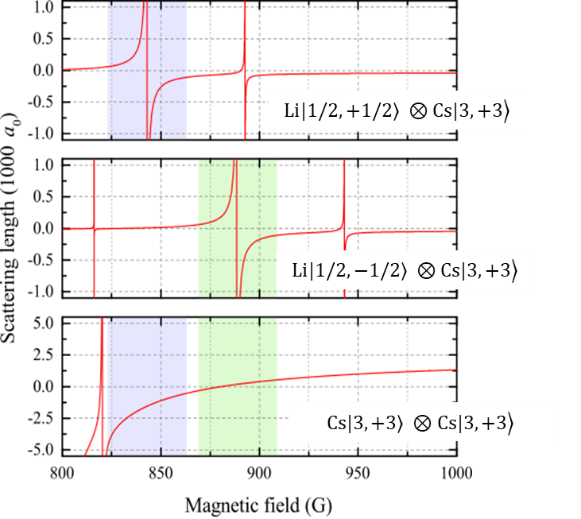
We investigate the quantum statistical properties of Li-Cs mixtures by controlling the inter-species interaction strength employing the unique richness of their Feshbach resonances. At sub-micro-Kelvin temperatures, through the application of a uniform external magnetic field, one can control the collisional properties of the gas and make the effective strength of two-body interaction either attractive or repulsive, arbitrarily large or small. By employing magnetic field-dependent atom-loss spectroscopy we observed several interspecies Fenshbach resonances in the Li-Cs mixture. We attributed the resonances to s-, p- and d-wave molecular channels by a coupled-channels calculation, leading to an accurate determination of Li-Cs ground-state potentials.
status: past project
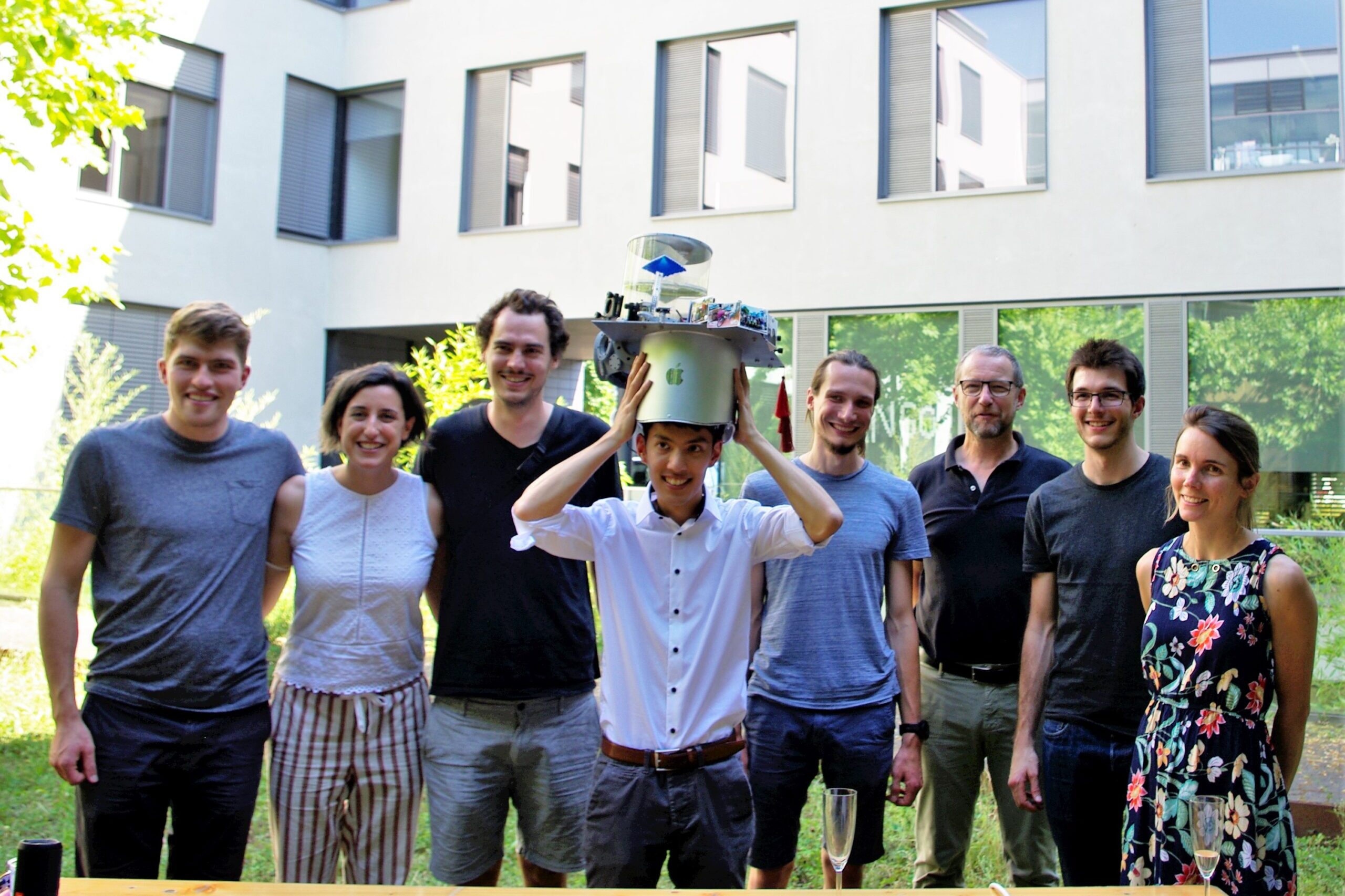
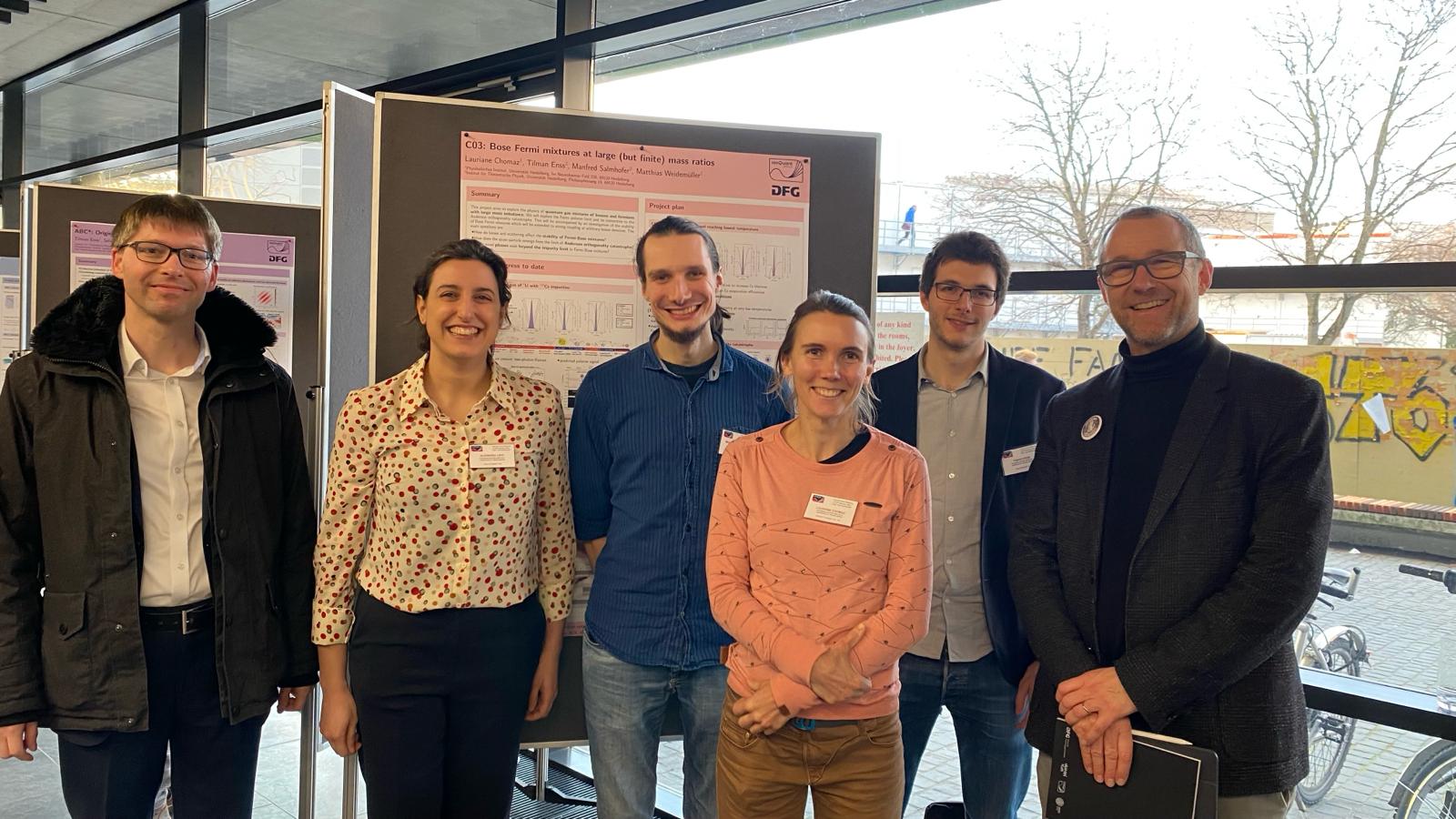
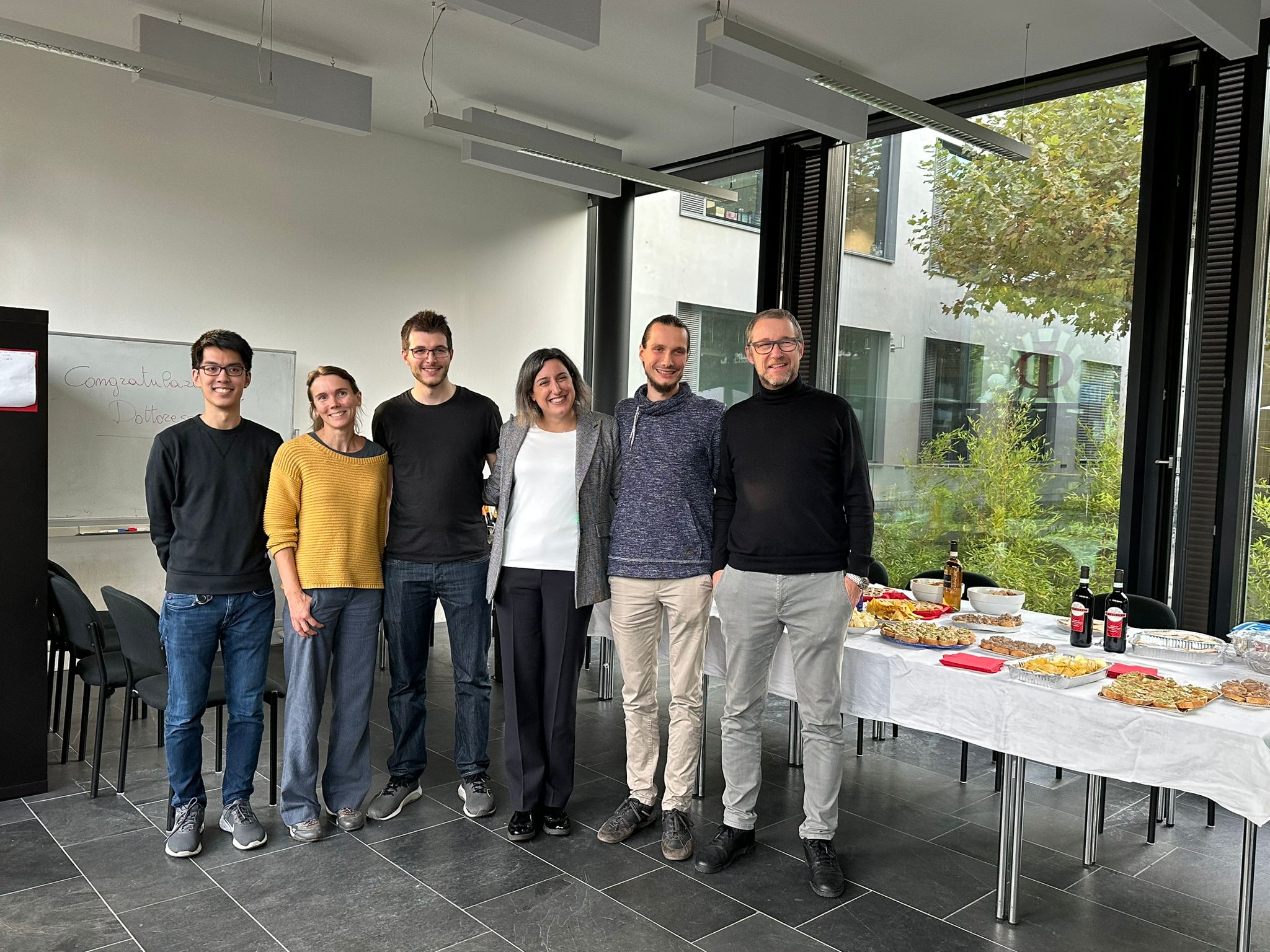
The Mixtures Team



Former PhD Students
Former Master Students
News from the Mixtures lab
- “An Experimental Platform for Studying the Heteronuclear Efimov Effect with an Ultracold Mixture of Li-6 and Cs-133 Atoms” now published on Few-Body Systems!
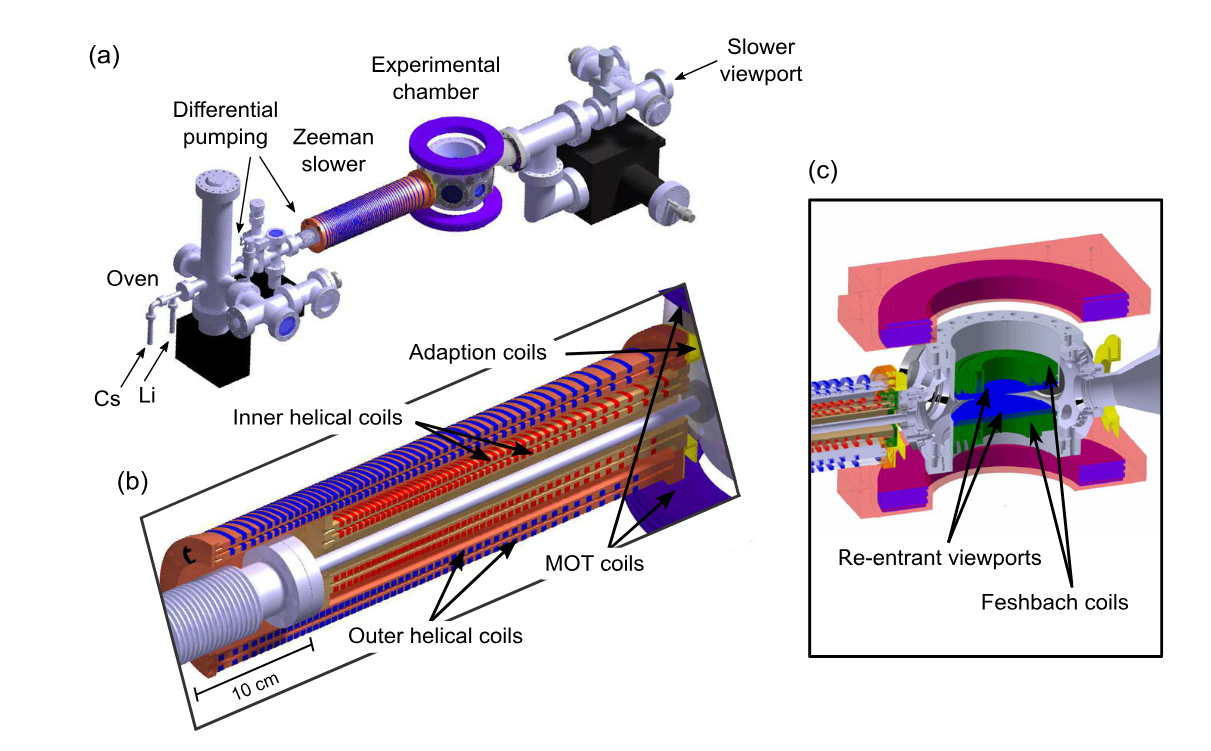 Our paper describing the Li-Cs mixing experimental apparatus has been now published in the journal Few-Body Systems! Experiments involving atomic… Read more: “An Experimental Platform for Studying the Heteronuclear Efimov Effect with an Ultracold Mixture of Li-6 and Cs-133 Atoms” now published on Few-Body Systems!
 - Congratulations to Dr. Lippi!
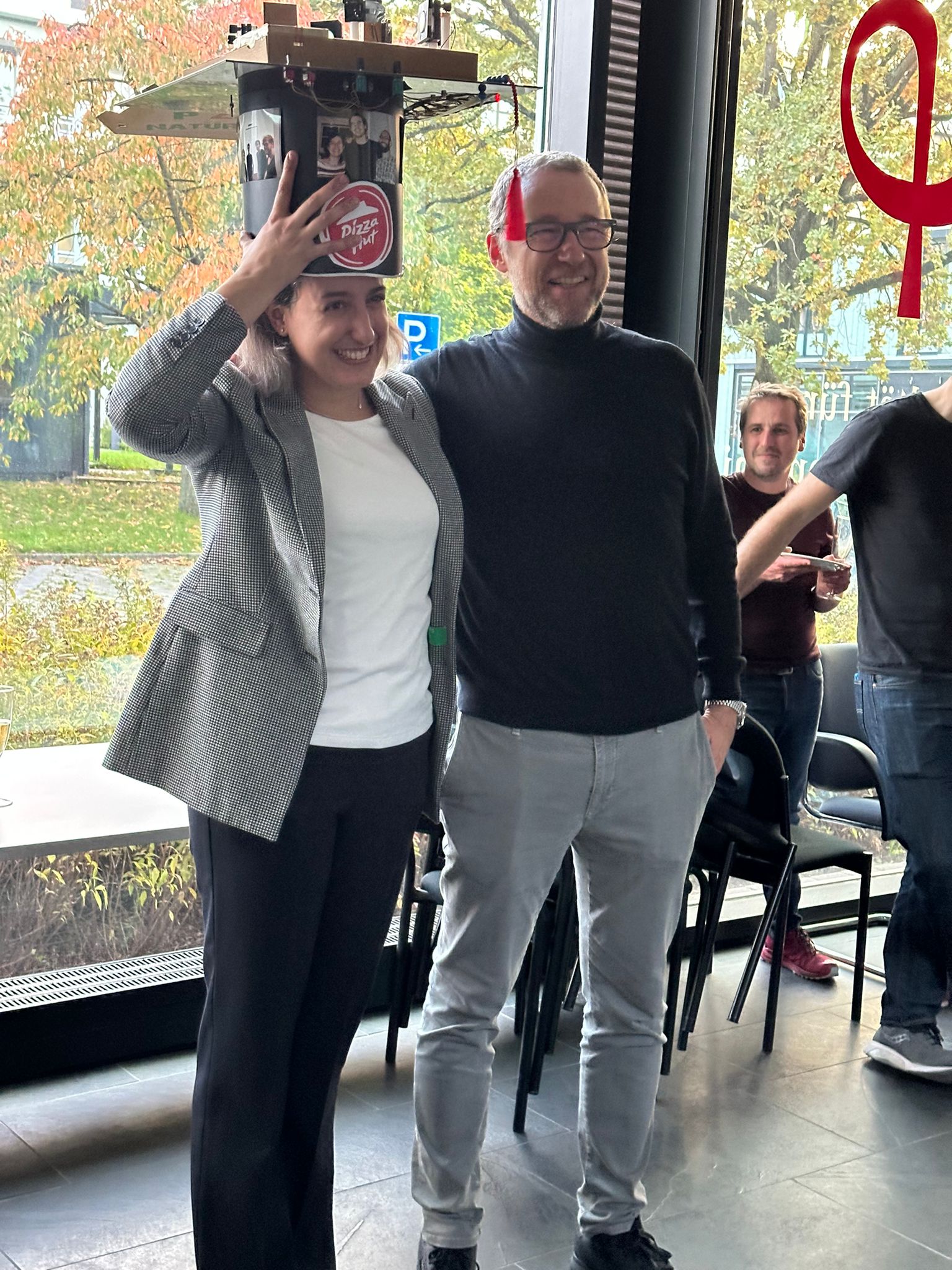 Congratulations to Eleonora Lippi who today defended her PhD thesis “Cs-133 atoms in a Li-6 Fermi sea for exploring polaron… Read more: Congratulations to Dr. Lippi!
 - “Anomalous loss behavior in a single-component Fermi gas close to a p-wave Feshbach resonance” published in Phys. Rev. A !
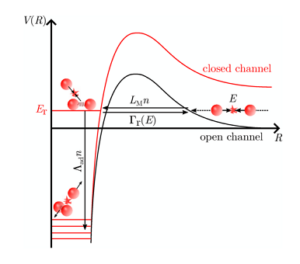 This month, our paper on “Anomalous loss behavior in a single-component Fermi gas close to a p-wave Feshbach resonance” was published… Read more: “Anomalous loss behavior in a single-component Fermi gas close to a p-wave Feshbach resonance” published in Phys. Rev. A !
 - Mixtures lab plays as “actor” in the video for promoting Isoquant
 The Mixtures lab appears in the video for promoting Isoquant CRC 1225. Check the video on YouTube! This image video… Read more: Mixtures lab plays as “actor” in the video for promoting Isoquant
Recent Publications
2023
Anomalous loss behavior in a single-component Fermi gas close to a p-wave Feshbach resonance Journal Article
In: Phys. Rev. A, vol. 107, iss. 5, pp. 053310, 2023.
2022
2021
Fermions meet two bosons — the heteronuclear Efimov effect revisited Journal Article
In: Braz. J. Phys., vol. 51, pp. 316, 2021.
2020
Scattering of two heavy Fermi polarons: resonances and quasi-bound states Journal Article
In: Phys. Rev. A, vol. 102, pp. 063321, 2020.
The HDvent Emergency Ventilator System Working paper
arXiv e-prints: 2012.13005, 2020.
2019
Observation of dipolar splittings in high-resolution atom-loss spectroscopy of $^6$Li $p$-wave Feshbach resonances Journal Article
In: Phys. Rev. A (Rapid Comm.), vol. 100, iss. 5, pp. 050701, 2019.
High partial-wave Feshbach resonances in an ultracold $^6$Li-$^133$Cs mixture Working paper
arXiv e-prints: 1912.01264, 2019.
Spin-rotation coupling in p-wave Feshbach resonances Working paper
arXiv e-prints: 1910.12011, 2019.
2017
Role of the intraspecies scattering length in the Efimov scenario with large mass difference Journal Article
In: Phys. Rev. A, vol. 95, iss. 6, pp. 062708, 2017.
Heteronuclear Efimov Scenario in Ultracold Quantum Gases Journal Article
In: Springer Theses, 2017.
2016
Heteronuclear Efimov scenario with positive intraspecies scattering length Journal Article
In: Phys. Rev. Lett., vol. 117, pp. 153201, 2016.
Heteronuclear Efimov resonances in ultracold quantum gases Journal Article
In: National Science Review, vol. 3, pp. 174, 2016.
Universal three-body recombination and Efimov resonances in an ultracold Li-Cs mixture Journal Article
In: Phys. Rev. A, vol. 93, iss. 2, pp. 022707, 2016.
2015
Universality of weakly bound dimers and Efimov trimers close to Li – Cs Feshbach resonances Journal Article
In: New J. Phys., vol. 17, iss. 5, pp. 055009, 2015.